
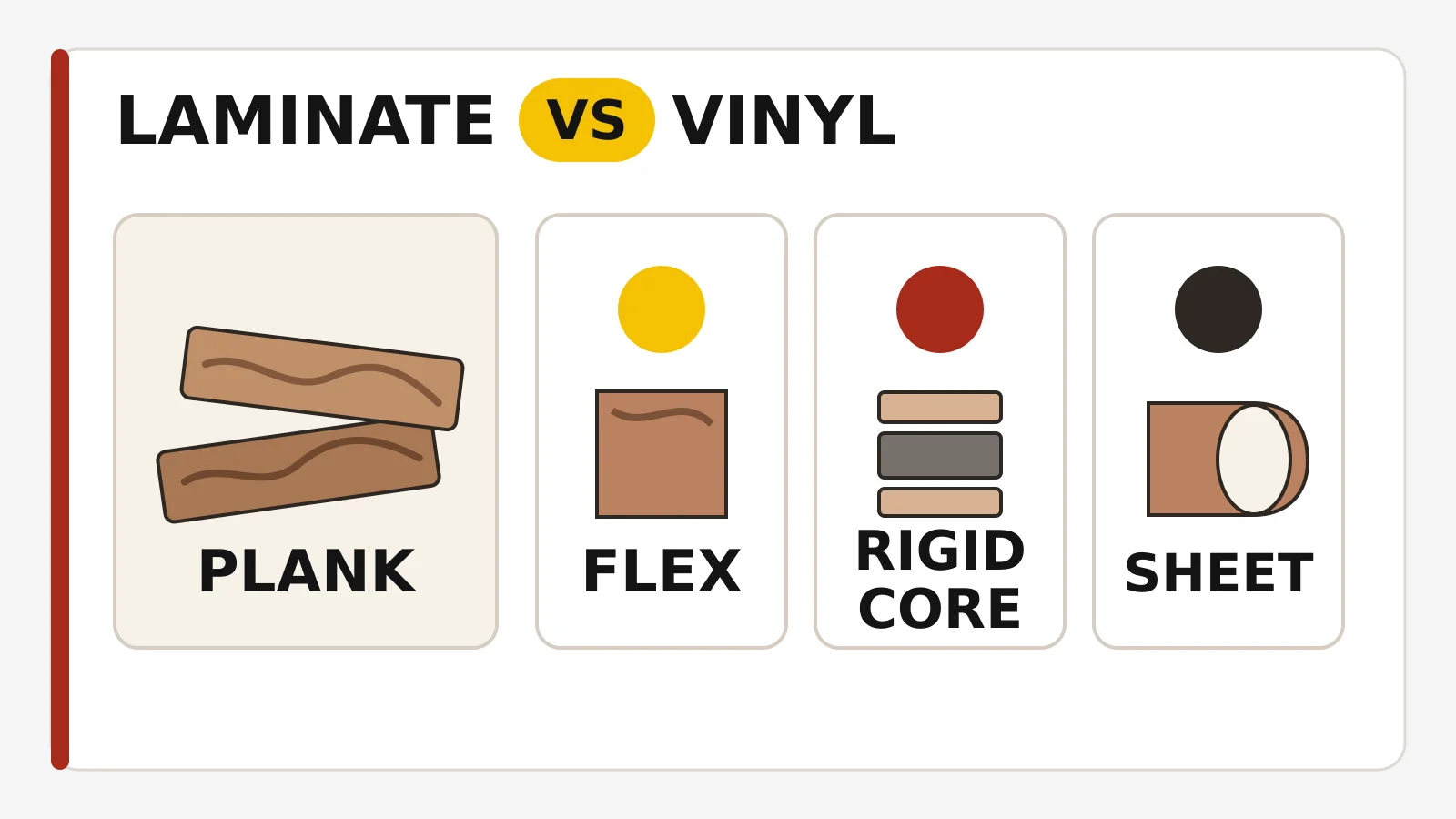
Quick answer: Neither laminate nor vinyl flooring is best for every room. Vinyl may enter the shortlist earlier where moisture exposure matters, while laminate may suit a dry room when its look, feel, and approved installation fit the space. The exact product’s water claim, room approval, subfloor requirements, and product documentation should decide the final choice.
Laminate vs. vinyl flooring at a glance
Laminate and vinyl can both create a wood or stone look, but they are different flooring categories. Each contains products with distinct constructions, water claims, installation methods, and documented limits.
| Decision factor | Laminate | Vinyl |
|---|---|---|
| Product format | Commonly sold as layered planks with a printed design surface | Includes flexible plank or tile, rigid-core flooring, and sheet formats |
| Moisture question | Check the spill rating, stated in hours, and the rooms the product is approved for; only a few laminates carry a waterproof rating | Check the exact water claim, format, seams, room approval, and documented exclusions |
| Design choice | Often selected for a wood, stone, or slate appearance | Available in plank, tile, and sheet designs, depending on the range |
| Feel and sound | Compare samples with the approved underlayment and subfloor | Compare the exact product, backing, underlayment, and installation method |
| Installation | Product instructions control preparation, acclimation, underlayment, expansion, and room use | Requirements vary among floating, glue-down, and sheet systems |
| Final decision | Best judged as a complete product and installation system | Best judged as a complete product and installation system |
Use the table to organize questions rather than declare a winner. A strong option for one room may be unsuitable for another room in the same home.
What is the difference between laminate and vinyl?
How laminate products are built
Laminate is a layered flooring product. Beaulieu Canada’s laminate overview shows one common build-up with a backing layer, a high-density fibreboard core, a printed design layer, and a protective surface. Constructions still vary, so use that description as an example rather than a specification for every product.
The same manufacturer separates regular laminate from water-resistant laminate. That distinction matters when comparing laminate flooring options. Ask for the documents attached to the exact colour and collection you are considering.
Why the type of vinyl matters
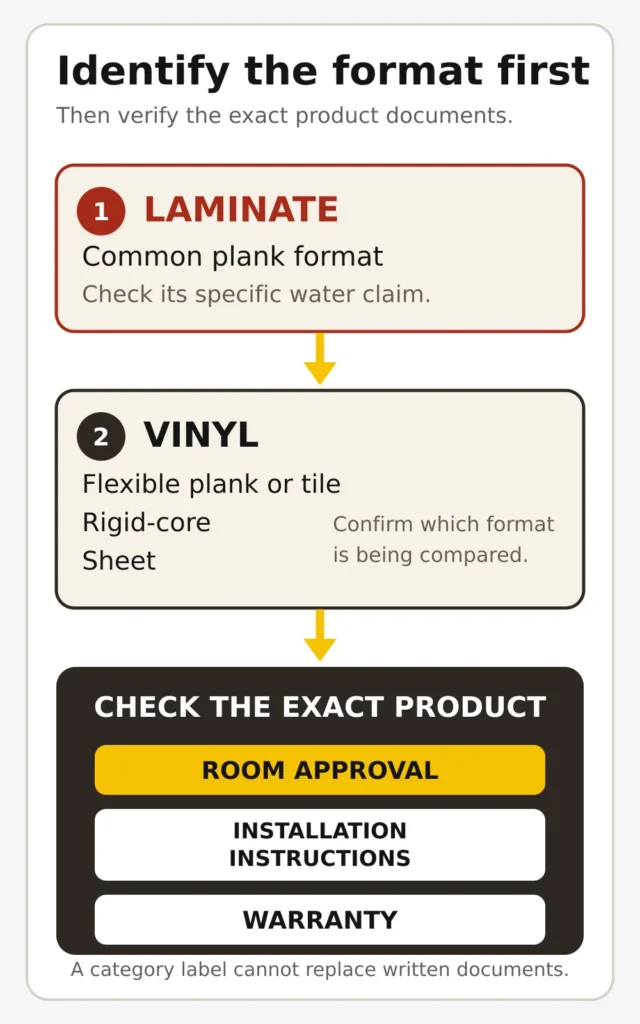
Vinyl is a broad label. The Resilient Floor Covering Institute distinguishes flexible luxury vinyl plank or tile, rigid-core flooring, and sheet vinyl. Beaulieu Canada’s vinyl overview also separates engineered luxury vinyl, glue-down luxury vinyl, and sheet products.
For a focused definition of one rigid-core format, read what SPC vinyl flooring means and which product documents still need to be compared.
Before comparing vinyl flooring options with laminate, confirm which vinyl format is on the table. A statement about one format may not apply to another.
Compare the factors that change the decision
Moisture exposure and water claims
Most vinyl planks are rated waterproof, which makes vinyl a sensible category for rooms where tracked-in water or spills are part of daily life. Water can still run through the seams and around the edges, and no vinyl product is floodproof or approved for every wet area.
Laminate water performance also varies. Read the water claim and product documentation together. Look for the approved rooms, spill exclusions, cleaning method, edge and perimeter requirements, and instructions for water that reaches beneath the floor. Fix active leaks and building-water problems before either floor is installed.
Appearance, feel, and sound
Start with samples you can see in the room’s actual light. Compare pattern repeat, plank size, edge detail, surface texture, and how the floor meets stairs, doors, cabinets, or adjoining rooms.
Feel and sound depend on more than the visible surface. The subfloor, backing, approved underlayment, installation method, room furnishings, and footwear can all affect the result. Base the comparison on the proposed assemblies rather than loose samples alone.
Daily wear, cleaning, and repairs
Describe the room honestly. Note pets, rolling chairs, grit at entrances, direct sunlight, children’s activities, mobility equipment, and how often spills occur. Then check which uses the product documentation covers and whether protective pads or mats are required.
Review the current care guide before buying. Confirm approved cleaners, vacuum settings, wet-cleaning limits, and how quickly spills should be handled. Ask whether a damaged plank can be replaced, what access the repair would require, and whether matching material will be retained.
Subfloor and installation requirements
Both categories depend on the surface underneath. Flatness, cleanliness, moisture, movement, old adhesive, floor height, and transitions can change the preparation and the final quote.
Product instructions cannot be swapped between floors that look similar. Beaulieu Canada’s current angle-to-angle guides set separate requirements for one laminate system and one engineered luxury vinyl system. Each addresses its own substrate, moisture, underlayment, and installation conditions.
Those guides illustrate the principle, but their technical limits apply only to the products they cover. Use the instructions and product documentation for the exact floor on your quote.
Compare the complete project scope
Material price alone does not describe the project. Preparation, underlayment, transitions, removal, waste, delivery, installation method, baseboards, doors, stairs, and appliance access may all affect the scope.
Ask for a quote that identifies the product and the work included. This makes two proposals easier to compare without relying on a broad claim that one category is always cheaper.
Which flooring fits different rooms?
- Living room, bedroom, or home office: In a dry space, compare the design, surface feel, sound, furniture loads, rolling-chair requirements, and cleaning routine. Either category may remain on the shortlist when the product is approved for the room.
- Kitchen or entrance: Water, grit, cleaning frequency, appliance movement, and transitions deserve extra attention. Vinyl may be considered early, but the exact product’s water definition and room approval still control.
- Basement: Moisture history and the concrete slab come before surface design. Use the separate guide to choosing flooring for a basement rather than assuming that any laminate or vinyl product is approved below grade.
- Bathroom or laundry area: Water can pool in these rooms, so laminate is rarely the choice; compare waterproof vinyl or porcelain tile instead. Confirm written room approval and every perimeter, seam, drain, appliance, and water-event condition. If the product documents do not permit the planned installation, remove that option from the shortlist.
Questions to ask before choosing
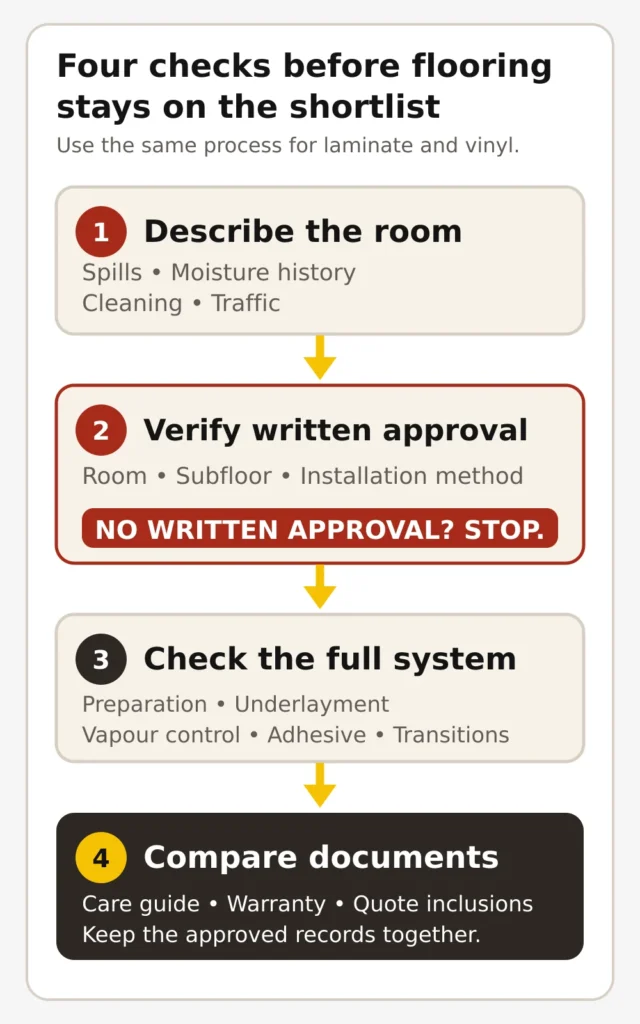
Take these questions to the showroom or consultation:
- What exact laminate and vinyl formats am I comparing?
- Is each product approved for this room, subfloor, and installation method?
- How does each product document define water-resistant or waterproof?
- What moisture testing and subfloor preparation are required?
- Does the system need an approved underlayment, vapour-control layer, adhesive, or expansion space?
- Which cleaning products, mats, chair pads, and maintenance methods are approved?
- How will the new floor meet doors, stairs, cabinets, appliances, and adjoining surfaces?
- What work, materials, documentation, and product records are included in the quote?
Keep the product name, colour, lot information, instructions, care guide, product documentation, test results, and quote together. If the product changes, repeat the review for the replacement.
Compare laminate and vinyl options with Ultra
Bring room photos, rough measurements, subfloor information, and notes about spills, pets, entrances, or past moisture when you compare products. Include stairs, doors, appliances, floor drains, and transitions in the photos.
Ultra Carpet & Flooring can help Mississauga homeowners compare current laminate and vinyl choices.
This article is a planning guide. The exact product instructions, room conditions, subfloor, complete installation system, and product documentation control the final choice.