
Quick answer: Carpet underpad is the layer installed between the carpet and the floor beneath it. It supports the carpet, changes how the floor feels underfoot and can influence sound within the room. The best choice is not automatically the thickest or softest option. It must suit the exact carpet, the room, expected foot traffic, the subfloor and the approved installation system.
Choose the carpet and underpad together, then make sure both are clearly identified in the written quote.
What does carpet underpad do?
Underpad (also called carpet cushion, padding, or underlayment) is an unseen part of the finished carpet system. Its main job is to provide a firm, resilient foundation beneath the carpet.
The Carpet and Rug Institute explains that a suitable cushion supports the carpet, acts as a shock absorber and contributes to comfort, acoustics and insulation. Those benefits depend on matching the cushion to the carpet rather than choosing it as a separate upgrade.
Underpad can affect:
- how firm or soft the floor feels;
- how the carpet responds to footsteps and furniture loads;
- how sound travels through the room;
- the finished height at doors, stairs and transitions; and
- how the carpet and installation system perform together.
It cannot correct an uneven or damaged subfloor. Preparation still needs to be assessed before installation.
Thickness and density are different
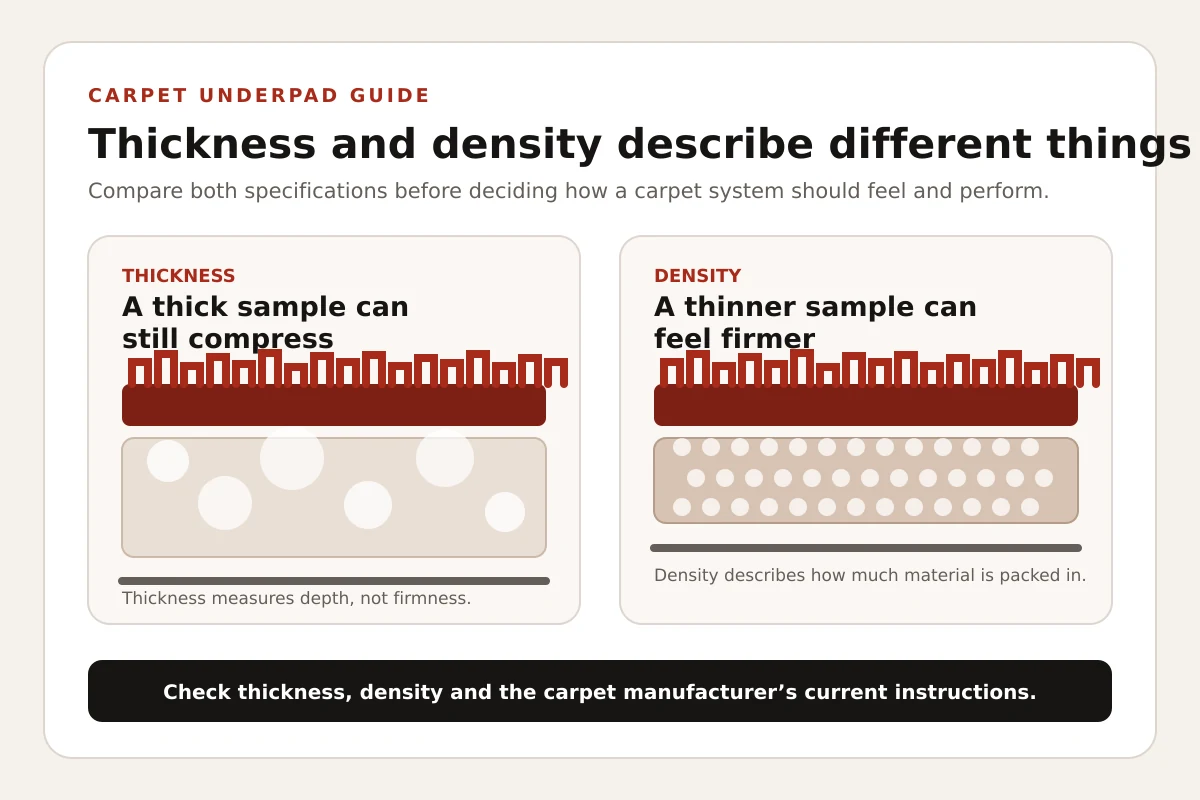
Thickness describes how deep the underpad is. Density describes how much material is packed into a given volume. A thick cushion can still be soft and highly compressible, while a thinner, denser option may provide firmer support.
That is why thickness alone does not tell you whether an underpad is suitable.
As a broad residential starting point, the Carpet and Rug Institute discusses cushion from 1/4 to 7/16 inch thick with at least 6 pounds per cubic foot of density for many residential carpets. For Berber, thinner-loop or low-profile carpet, its general guidance calls for a firmer cushion no thicker than 3/8 inch, with 8-pound density.
These figures are general guidance, not a specification for every carpet. Check the current instructions for the exact product before selecting the underpad.
Match the underpad to the carpet construction
The visible carpet should lead the decision. Its construction, backing and installation instructions determine what belongs underneath it.
Cut-pile carpet
Cut-pile styles vary from dense, low-profile products to softer carpets with a taller surface. Compare the carpet sample over the proposed underpad, not just on its own. A very soft cushion may change the feel dramatically without being the right support for that product or room.
Loop and Berber-style carpet
Loop and low-profile carpets generally need a stable, low-flexing cushion. Too much movement beneath the carpet can work against the firm support the construction requires.
If this is the carpet style you are considering, use our Berber carpet buying guide to compare loop construction, fibre, room fit and care, then confirm the approved underpad for the selected product.
Patterned carpet and stairs
Pattern alignment, seams, stair details and finished height all belong in the installation plan. The underpad must work with the chosen carpet and the way it will be fitted. Discuss these details during measurement rather than leaving the cushion decision until installation day.
Match the underpad to the room
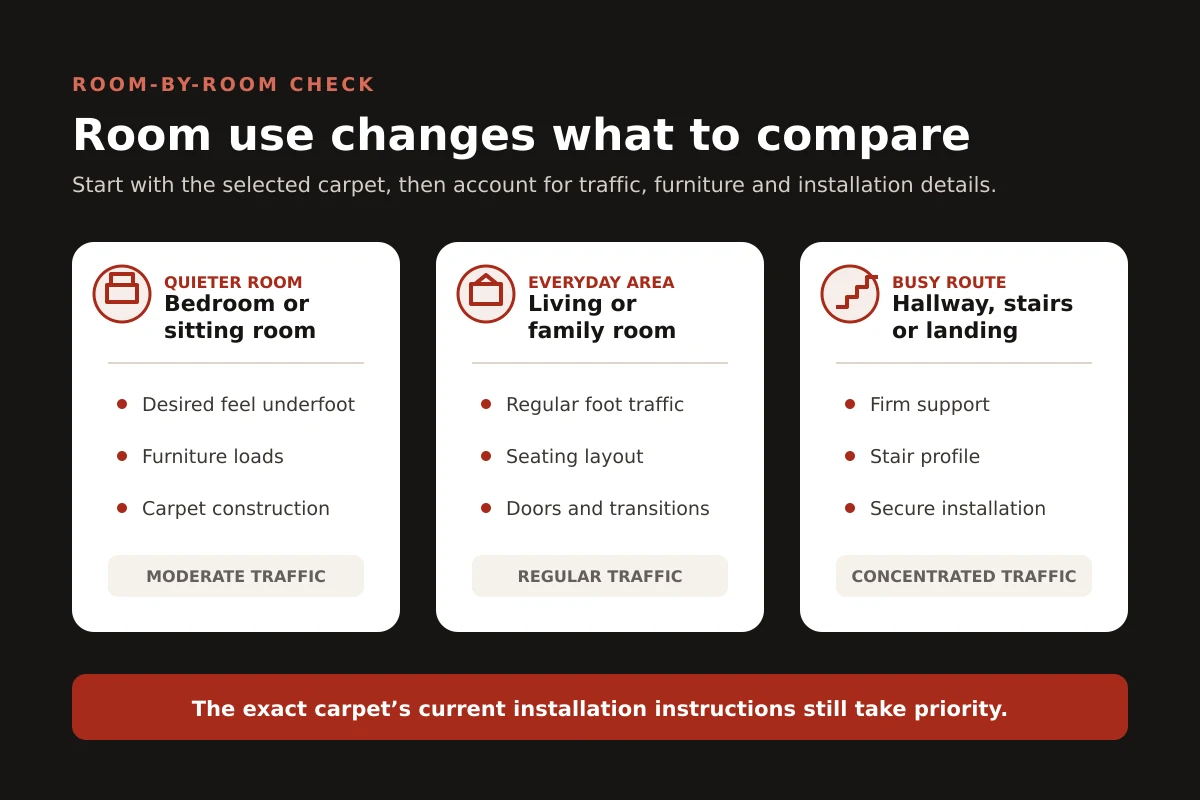
Room use helps determine how firm the cushion should feel and how much traffic it needs to support.
| Room or condition | What to compare |
|---|---|
| Bedroom or quiet sitting room | Desired feel, furniture loads, carpet construction and moderate traffic |
| Living room or family room | Regular traffic, seating layout, doors and transitions |
| Hallway | Concentrated foot traffic and the need for firm support |
| Stairs and landings | Carpet construction, stair profile, secure fit and installation method |
| Home with pets | Cleaning plan, exact barrier construction where offered and how spills are handled |
| Room over a concrete floor | Subfloor condition, moisture assessment and the complete approved carpet system |
The Carpet and Rug Institute notes that lighter-traffic rooms may suit a softer or thicker cushion, while hallways, stairs, living rooms and other busy areas generally call for a thinner, firmer option. The exact carpet instructions still take priority.
If the room has a history of dampness or leakage, correct the source before installing carpet. A barrier attached to an underpad does not repair plumbing, drainage or subfloor moisture problems, and it does not make the room waterproof.
Common carpet underpad materials
Several broad cushion categories are available. Product names and constructions vary, so compare the actual specification rather than relying on the category alone.
Polyurethane foam
This category includes different foam constructions and firmness levels. Bonded foam, often called rebond, is a common form made from bonded pieces of foam. Compare density, thickness, feel and compatibility with the selected carpet.
Rubber
Rubber cushions are available in different constructions and firmness levels. Ask how the proposed product suits the room, carpet and installation method rather than assuming every rubber underpad behaves the same way.
Fibre cushion
Fibre underpads can also provide firm support. Review their composition, thickness, density or weight information, and the carpet manufacturer's installation requirements.
Some products add features intended for pet households, spill management or lower-emission material selection. Treat each feature as a product-specific claim: ask what it covers, what it does not cover and what cleaning or installation rules apply.
Can you reuse existing underpad?
Do not assume that existing underpad is reusable simply because it remains in place when the old carpet is lifted.
Its condition, age, compression, odours, stains, contamination, seams and fit all need assessment. The new carpet may also require a different thickness, density or cushion construction. Reusing an unsuitable pad can leave a new carpet with uneven support or the wrong finished height.
The written scope should state whether the existing underpad will be removed, how the exposed floor will be assessed and which new material is included if replacement is needed. Ultra Carpet's carpet installation page lists the other details to confirm, including removal, preparation, seams, stairs, and transitions.
Questions to ask before approving the quote
- What is the exact name and construction of the proposed underpad?
- What are its thickness and density or weight specifications?
- Does it meet the current installation requirements for this exact carpet?
- Is the firmness appropriate for the room, traffic level and carpet construction?
- Does the carpet require a different cushion on stairs or other detailed areas?
- How will the underpad affect door clearance, floor height and transitions?
- Is removal and disposal of the existing carpet and cushion included?
- What subfloor assessment or preparation is included before the new system is installed?
- If a spill or pet-related feature is proposed, what does that feature actually cover?
- Will the product name and specifications appear in the written quote?
Keep the quote and product instructions together. If the carpet changes, recheck the underpad rather than assuming the first selection still applies.
Compare carpet and underpad together
Underpad should not be an unnamed extra added after the carpet decision. It is part of the complete system and should be selected for the carpet, room, subfloor and installation plan.
Start by exploring carpet options in Mississauga or comparing five common carpet styles. When you have a shortlist, bring room measurements, photos and information about stairs, pets and busy walkways to the showroom.
Contact Ultra Carpet & Flooring